Crossing the Uncanny Valley with Nuance Labs
Shaping AI to humans, not the other way around
Jonathan Brebner · September 14, 2026
Over 50 years ago, a Japanese roboticist named Masahiro Mori drew a simple graph. The x-axis represented how realistic a human likeness was, while the y-axis represented how positively people reacted. We tend to like things more and more as realism increases. But just before you reach full human likeness, the line plummets—into the uncanny valley.
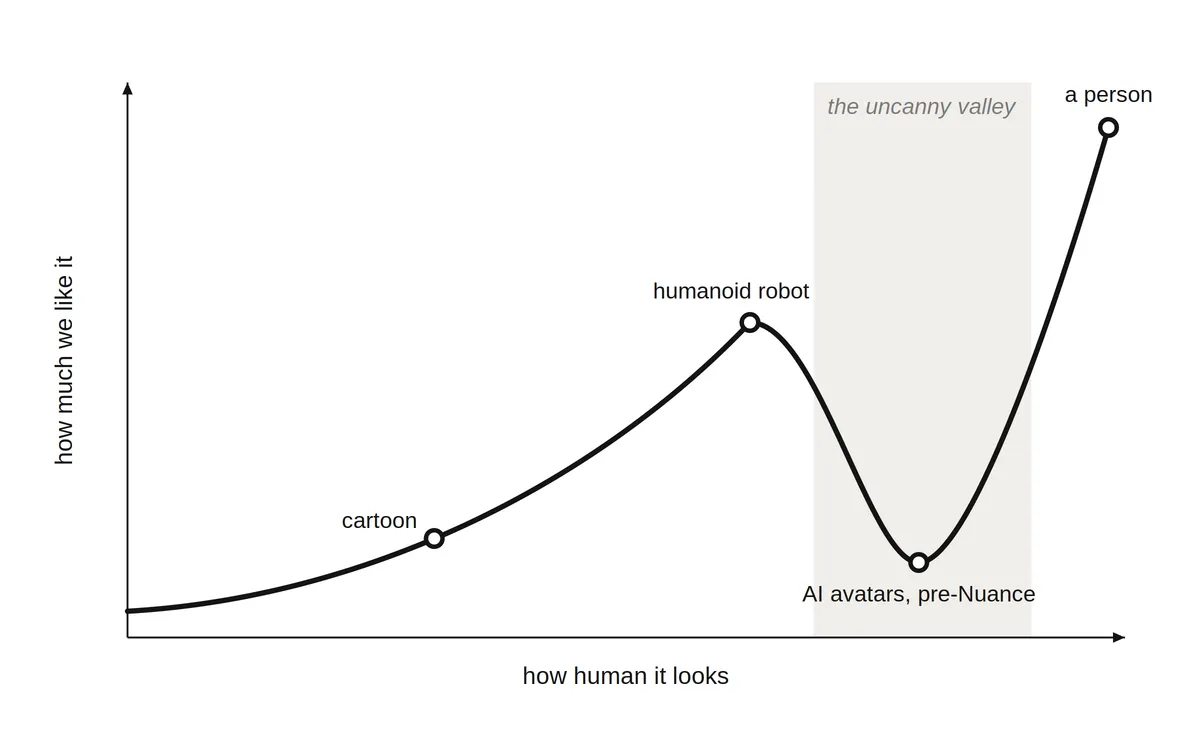
Up until very recently, every attempt at creating realistic AI avatars fell into the valley. They improved along nearly every axis, yet still came across as stiff and artificial. The valley remained an obstacle for anything you might want to build on the other side.
Nuance Labs has figured out how to cross it.
Before Nuance, face-to-face interaction with AI worked sort of like a relay race, with one model handing off to another and another to coordinate across modalities and ultimately produce an avatar that feels…dead behind the eyes. Each handoff introduces just a tiny bit of delay and miscoordination, simulating interactive behavior that doesn’t feel interactive. In turn, this forces people to reshape their communication to the unnatural cadences of AI. We were forced to stumble our way through the valley.
Nuance co-founders Fangchang and Edward joined SPC to traverse the pitfall, having become very familiar with the difficulty of generated human likeness while working on the Personas feature for the Apple Vision Pro. The solution they, later co-founder Karren Yang, and the insanely talented research team they’ve assembled in Seattle came up with is a full duplex emotional and conversational model. It perceives and reacts at the same time, generating an avatar that listens, reacts, and communicates in the way you expect from a normal conversation.
The result is striking. It’s hard to articulate what’s been missing until suddenly it isn’t, and very quickly your mind turns to what’s become possible. This is wild country beyond the valley, terrain the Nuance team has earned the right to explore and the responsibility to map.
We wrote Nuance’s first check in the Founder Fellowship and have participated in every round since. From the beginning, many of the product applications of their technology were obvious, covering anything where you might use an AI avatar. But what has become apparent with their latest technical leap is just how important emotional understanding will be for the future of AI and human interaction in a much broader sense.
Words are lossy. When people interact, often most of the important information they exchange is non-verbal: a tilt of the head, the crinkle around the eyes, the tone of their voice. We show we’re listening by nodding along and affirmation by laughing. Evolution spent millions of years making us exquisitely effective social communicators. What we really mean is in the nuances.
If we want AI to follow our intent, it needs to accurately perceive what we intend. And it needs to communicate, collaboratively, naturally, in the ways that humans find most natural, not the ways that are easiest for machines. This will be true for any embodied AI—avatars, robots, and everything in between. By making AI more human, Nuance Labs keeps humans at the center of AI.