Investing in TenX Semi
Superhuman chip design
Mark Jacobstein · September 1, 2026
The entire modern economy runs on semiconductors, whose designs are one of the great marvels of engineering and FUs to entropy in human history.
Most of us don't think a lot about how these chips work; we just enjoy the fruits of their (blazing, miraculous) labors—the software that sits on top and powers nearly everything we do.
And for those of us naive CS types whose last experience with EE was learning to build an adder, we assume that the semiconductors beneath our software are "always correct". Silicon is deterministic, and the bits aren't ever wrong, right?
Turns out it's not that simple.
Chip-design organizations face growing pressure to do more with the same resources. As designs grow more complex, teams must move faster without lowering design quality. In the age of agentic chip design, verification is becoming the bottleneck, and AI cannot transform chip design when design and autonomous verification do not progress hand in hand. Solving this bottleneck before the chips are taped out (let alone shipped) is the work of TenX Semi.
I'm proud to announce today that South Park Commons and Khosla Ventures led TenX's early funding. We've believed in their mission from the start.
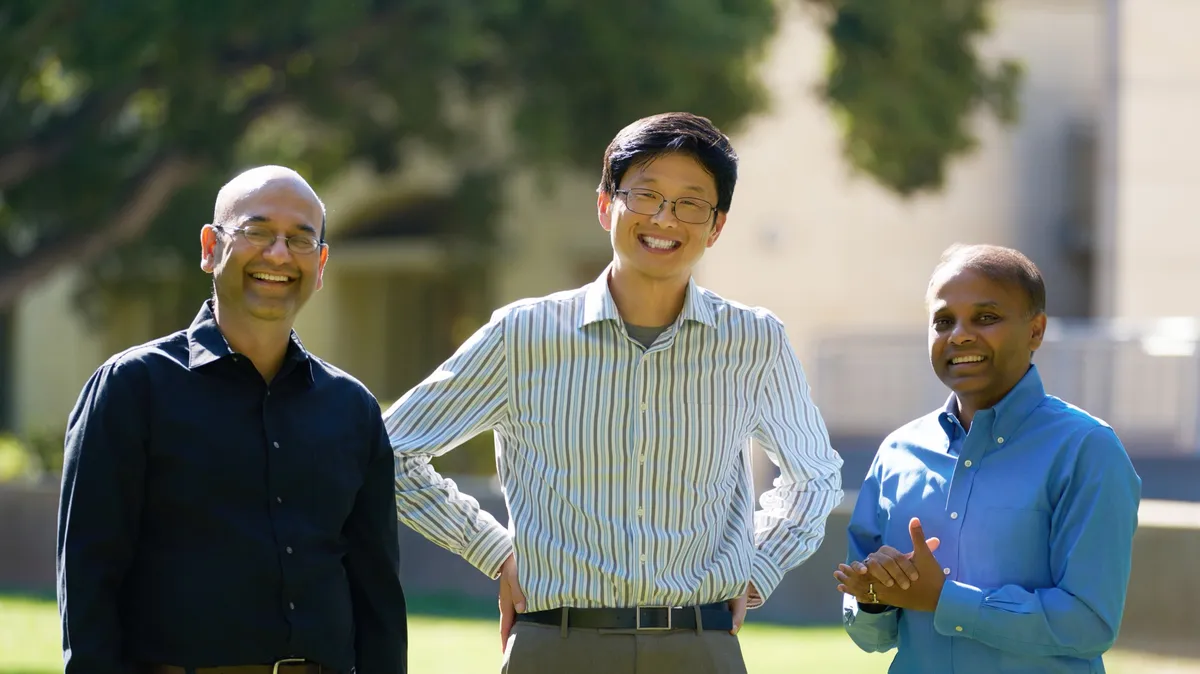
The team of CEO SukHwan Lim (former EVP at Samsung, where he ran all US R&D for System LSI semiconductors), Subhasish Mitra (Stanford Professor and EE legend in robust and dependable computing and 3D nanotechnologies), and Shwetabh (Shwe) Verma (Broadcom, Apple, Cadence) is extraordinarily well-positioned for this business. My first notes after meeting SukHwan ("finishing my sentences, genuinely three steps ahead") made this an easy investment decision, as did their first hire of Joachim Kunkel, former EVP and GM at Synopsys.
Subhasish's foundational work transformed formal verification into a scalable, high-throughput reality. By shifting the paradigm toward automated consistency analysis, TenX Semi's autonomous verification platform uncovers bugs (including deep, hard-to-find long-tail bugs) without requiring additional test writing. The result is unprecedented speed and design quality, enabling teams to do far more with the same resources. At a top-ten semiconductor company, TenX Semi's platform uncovered critical bugs in a production design in less than two weeks, which would take many months to accomplish using business-as-usual practices.
Today, TenX Semi is advancing chip design by combining autonomous verification with AI-powered bug localization and fixing. In TenX Semi's vision, design and autonomous verification progress hand in hand, and bugs uncovered in the process are fixed autonomously. TenX Semi calls this the "self-verify-and-fix" loop, which dramatically shortens design timelines while improving design quality.
Special thanks to Tathagata (T) Srimani, co-founder and CTO of SPC portfolio company Flucta, for the introduction to the TenX team. Before T was a rising-star Professor at Carnegie Mellon, he studied under Subhasish. I met T through Raman Vilkhu (huge shoutout here as well), another former Stanford EE PhD student of Subhasish.
In fact, this whole story is an ode to the value of the Stanford EE network; SukHwan, Subhasish, and Shwe met as grad students at Stanford twenty years ago. A few weeks after investing, I hosted a summit on the future of semiconductors and algorithms on campus, featuring SPC companies TenX, Flucta, Matter42, Density AI, and Ranvier Labs, as well as several Stanford professors. It will surprise no one who knows Subhasish that his presentation on the future of semiconductors framed the whole day.
The move from simulation to formal verification, and then to optimization and AI-assisted development, heralds an exciting new era for the semiconductor industry, the most critical infrastructure underpinning the entire AI era.